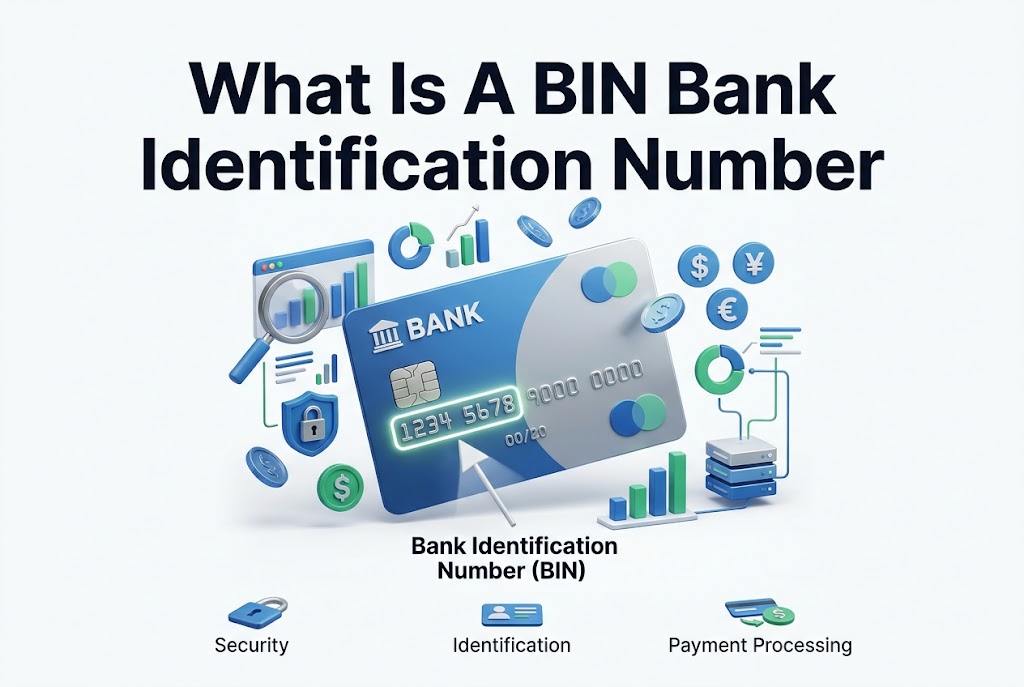
When a payment card is used online or in a store, the first few digits often reveal important information about the card. These digits are known as a BIN, or Bank Identification Number. If you have searched for “what is a bin bank identification number,” you are likely trying to identify a card issuer, verify a payment, investigate a suspicious transaction, or understand how payment processing works.
A BIN is the first six to eight digits of a debit card, credit card, prepaid card, or other payment card number. It helps payment networks and merchants determine which financial institution issued the card and how the transaction should be routed. A BIN may also indicate the card network, card type, country of issuance, and sometimes whether the card is linked to a bank account or prepaid balance.
This article explains what a BIN contains, how it is used, where to find it, how to check one safely, and why BIN information matters for fraud prevention and online payments.
What a BIN Identifies
A Bank Identification Number is the sequence of digits at the beginning of a payment card number. Historically, BINs contained six digits, but many payment systems now use eight-digit issuer identification numbers to support the growing number of cards in circulation.
The BIN identifies the financial institution or organization that issued the card. It does not identify the individual cardholder. For example, a BIN database may show that a card was issued by a particular bank in the United States and operates on the Visa network, but it will not reveal the customer’s name, account balance, address, or full transaction history.
The BIN is used behind the scenes during a card transaction. When a cardholder enters payment details, the merchant’s payment processor reads the opening digits and uses them to route the authorization request through the appropriate card network and issuing institution.
BIN and IIN terminology
BIN stands for Bank Identification Number, while IIN stands for Issuer Identification Number. The terms are often used interchangeably, although IIN is technically broader because not all issuers are traditional banks.
A card may be issued by a credit union, fintech company, payment provider, government organization, or other authorized institution. For that reason, some industry professionals prefer IIN, but “BIN” remains the term most people see in payment tools and fraud prevention systems.
Information commonly linked to a BIN
A BIN lookup may provide several details associated with
- Issuer or financial institution
- Card network, such as Visa, Mastercard, American Express, or Discover
- Card type, such as debit, credit, prepaid, or charge
- Country where the card was issued
- Issuer country code
- Card level or product category
- Sometimes the issuing bank’s website or contact information
The accuracy and depth of this information depend on the database being used. A free lookup may provide only basic details, while a commercial fraud prevention service may update its records more frequently and offer additional risk indicators.
How BINs Work During a Card Payment
A payment card number is not a random string of digits. Each portion serves a purpose within the payment system. The BIN appears at the beginning, followed by an account identifier and a final check digit used to help detect data-entry errors.
When a customer attempts a purchase, the merchant or payment processor reads the card number. The opening digits help determine where the authorization request should go. The request then travels through the relevant payment network to the issuing institution, which decides whether to approve or decline the transaction.
The issuer evaluates factors such as available funds, credit limits, card status, transaction amount, location, merchant category, and fraud signals. The response travels back through the network to the merchant. This process usually takes only a few seconds, but the BIN helps direct the request correctly from the start.
The main parts of a payment card number
Although card numbering systems vary, a typical card number includes three functional areas:
1. The BIN or IIN identifies the issuer and helps route the transaction.
2. The account number identifies the specific card account associated with the issuer.
3. The final digit acts as a check digit, often calculated using the Luhn algorithm.
The check digit does not prove that a card is active or belongs to the person using it. It only helps detect certain number-entry mistakes. A card number can pass a mathematical check and still be invalid, expired, blocked, or fraudulent.
Why the first digits matter
The first digits may help a merchant confirm whether a card fits the expected payment method. For example, a business may treat debit, credit, and prepaid cards differently when applying restrictions or evaluating risk.
A card’s BIN can also help identify mismatches. A customer may place an order from one country while using a card issued in another. That does not automatically indicate fraud, because people travel, work internationally, and use foreign cards. Still, the mismatch may become one factor in a broader review.
BIN Versus Other Card Information
BIN details are only one part of the information associated with a payment card. Confusing a BIN with other card data can lead to incorrect assumptions about what a lookup can reveal or how a payment should be protected.
The BIN is not the same as the full card number, expiration date, security code, cardholder name, or billing address. It is a classification and routing identifier, not a secret credential that authorizes a payment by itself.
BIN versus full card number
The BIN is only the opening section of the card number. The remaining digits identify the individual account and complete the payment card number. A BIN alone cannot normally be used to make a purchase because it does not identify a specific card account.
The full card number should still be treated as sensitive information. Even when the BIN is public or searchable, the remaining card details must not be shared casually, posted online, or entered into untrusted websites.
BIN versus CVV or security code
The CVV, CVC, or security code is a separate security feature printed on the card or encoded in its payment data. It is commonly used to help verify that the person making an online purchase has access to the physical card.
A BIN cannot replace a CVV. Knowing a card’s issuing bank and network does not provide authorization to complete a transaction.
BIN versus routing number
A bank routing number identifies a financial institution for certain bank transfers, direct deposits, and automated clearing transactions. A BIN identifies a payment card issuer or issuer range. They belong to different payment systems and should not be treated as interchangeable.
If you are setting up a bank transfer, you usually need an account number and routing details. If you are processing a card payment, the BIN helps identify the card issuer and network.
Comparison of Common Payment Identifiers
| Identifier | Main purpose | Common use |
|—|—|—|
| BIN or IIN | Identifies the card issuer and routes card payments | Card processing and fraud screening |
| Full card number | Identifies a specific payment card account | Purchases and account verification |
| CVV or CVC | Provides an additional card security check | Online and card-not-present payments |
| Routing number | Identifies a bank for account-based transfers | Direct deposits and bank transfers |
| Account number | Identifies a bank or card account | Payments, transfers, and account access |
Where to Find a Card’s BIN
For most payment cards, the BIN is found at the beginning of the card number printed on the front or back. Depending on the issuer and card design, the number may appear in groups of four digits or as a continuous sequence.
If the card number is 1234 5678 9012 3456, the six-digit BIN would traditionally be 123456. In systems that use eight-digit issuer identification, the relevant range may be 12345678. The exact format depends on the card network and the payment system interpreting the number.
You may also find the card number in a banking app, digital wallet, online account, or transaction receipt. Digital cards can use numbers that differ from the physical card, so check the exact card number involved in the payment.
Finding a BIN in a transaction
Merchants and payment professionals should avoid storing or displaying full card numbers unless they have a legitimate business need and meet applicable security requirements. Many payment dashboards show only the first six or eight digits and the last four digits.
A transaction record may display information such as:
- First six or eight digits
- Last four digits
- Card brand
- Card type
- Issuing country
- Authorization result
This limited display helps staff identify a card while reducing exposure of sensitive payment data.
Using a digital wallet
Digital wallets may use tokenized card numbers instead of the number printed on the physical card. A token has a different number range and may produce BIN details associated with the wallet token or tokenization service rather than the underlying card.
This is normal and does not necessarily mean that the card information is incorrect. If a wallet payment appears to have an unfamiliar BIN, the merchant should review the payment processor’s documentation and transaction data rather than drawing conclusions from the digits alone.
How to Perform a BIN Lookup
A BIN lookup uses a searchable database to match the opening digits of a card with information about the issuer and card product. These tools are commonly available through payment service providers, fraud prevention platforms, card testing systems, and public lookup websites.
To perform a basic lookup, enter only the first six or eight digits into a reputable service. Do not enter the full card number, expiration date, CVV, PIN, password, or other personal information. A legitimate BIN lookup generally does not need the complete payment credentials.
Steps for a safe lookup
1. Identify the first six or eight digits of the relevant card number.
2. Confirm that you are using a reputable lookup provider.
3. Enter only the BIN or IIN requested by the tool.
4. Review the issuer, network, card type, and country details.
5. Compare the result with the transaction information and customer context.
6. Remove or protect any copied card data after completing the check.
A lookup can support an investigation, but it should not be the only reason to approve or reject a transaction. BIN records may be incomplete, outdated, or affected by card tokens and virtual card products.
What a lookup result may show
A typical result might identify a card as a Mastercard debit card issued by a bank in Canada. Another result could indicate a prepaid Visa card issued by a payment company in the United Kingdom.
Some services also provide information about card funding, commercial or consumer classification, issuing region, and possible prepaid status. These fields should be treated as indicators rather than absolute proof, especially when the card is virtual, tokenized, recently issued, or part of a portfolio transfer.
Why BINs Matter to Merchants and Payment Teams
BIN information helps merchants make faster and more informed payment decisions. It can assist with routing, fraud screening, customer support, reporting, and payment method configuration.
An online retailer may use BIN data to identify whether a transaction comes from a prepaid card, a commercial card, or a card issued outside the merchant’s primary market. A subscription company may use it to monitor payment failures by issuer. A marketplace may review unusual concentrations of transactions from a particular issuer range.
Fraud prevention applications
Fraud systems can compare BIN data with other signals, such
- Billing and shipping country
- Device location
- IP address
- Account history
- Transaction value
- Velocity of attempts
- Failed security checks
- Previous chargebacks
- Email and phone reputation
A BIN mismatch is not proof of fraud. A legitimate customer may be traveling or purchasing a gift for someone in another country. The safest systems use BIN information as one input in a broader risk model.
Payment routing and acceptance
Some merchants use BIN ranges to determine which payment processor, acquiring bank, or authentication flow should handle a transaction. This may help support local payment requirements, currency handling, or network-specific processing.
Card networks may update BIN ranges, and issuers may introduce new products. Businesses that rely on static lists can experience incorrect declines or outdated classification. Regular data maintenance is important when BIN logic affects payment acceptance.
Customer service and reporting
Support agents may use the first digits and last four digits to identify the card used for a transaction without exposing the full number. This is especially helpful when a customer has multiple cards saved to an account.
Businesses can also analyze transactions by issuer, card type, or region. These reports may reveal payment failure patterns, customer preferences, or unusual activity that deserves further review.
BINs and Online Fraud Protection
BIN data can help identify card-testing activity, where criminals attempt many small transactions to determine whether stolen card numbers work. A sudden increase in attempts from related BIN ranges may signal automated abuse, particularly when combined with repeated declines, unusual device activity, or rapid account creation.
Fraudsters may also use prepaid or virtual cards because they can be obtained quickly and may be harder to connect to a verified identity. That does not make every prepaid or virtual card suspicious. Many legitimate customers use them for budgeting, privacy, travel, or controlled spending.
Warning signs that deserve review
A transaction may warrant additional checks when several
- The card’s issuing country conflicts with account activity and delivery details.
- Many cards from the same BIN are tested against one account.
- Repeated attempts use different cards but the same device or IP address.
- The transaction amount is unusually high for the customer’s history.
- A prepaid card is used for a high-value purchase with urgent delivery.
- Several authorization attempts occur within seconds.
The right response may be a step-up authentication request, manual review, temporary hold, or decline. Policies should be consistent and should avoid treating nationality or location alone as evidence of wrongdoing.
Protecting customers from BIN scams
Some criminals use BIN-related language to make scams sound technical. They may claim that a person can generate money, validate cards, or access accounts using a BIN. These claims are misleading. A BIN does not provide access to funds and cannot create a legitimate payment card.
Never share your full card details, PIN, one-time passcode, or online banking password with someone who says they need them for a BIN check. If a message asks you to send card information through email, social media, or an unfamiliar form, contact the card issuer through an official channel.
Limitations of BIN Databases
BIN lookups are useful, but their results are not always complete or current. Banks may introduce new card products, transfer portfolios, change processors, or issue cards through partner institutions. A database that has not been updated may identify the wrong issuer or card type.
The move from six-digit to eight-digit issuer identification also creates challenges. A six-digit lookup may group multiple products together even though their features, countries, or funding types differ. For accurate payment decisions, businesses should use data sources that support the relevant network standards.
Common sources of inaccurate results
A result may be misleading when:
- The card is virtual or tokenized.
- The issuer recently changed its BIN range.
- The database uses old information.
- A fintech program manager issued the card on behalf of another institution.
- The card is co-branded or part of a complex issuing arrangement.
- The first six digits do not distinguish between multiple products.
- The lookup provider uses incomplete regional data.
When a result conflicts with information from the payment processor, the processor’s transaction record and official documentation should generally receive more weight.
BIN country is not the customer’s location
The country associated with a BIN is the card’s issuing country, not necessarily the cardholder’s current location, nationality, residence, or delivery address. A person can legally hold a card issued in one country while living, traveling, or shopping in another.
This distinction matters for fraud analysis and customer service. A country mismatch may be worth reviewing, but automatic rejection can cause unnecessary declines and frustrate legitimate customers.
Common Mistakes When Checking a BIN
One of the most serious mistakes is entering the complete card number into a website that only requires the BIN. The extra digits provide no benefit for a basic lookup and increase the risk of exposing payment information.
Another mistake is assuming that the lookup result proves ownership, validity, or available funds. BIN data identifies an issuing range. It does not confirm that a card is active, that a transaction is authorized, or that the person using it is the cardholder.
Avoid these common errors:
- Sharing the full card number when six or eight digits are enough
- Treating a BIN lookup as a card validation service
- Assuming the issuer country proves the customer’s location
- Rejecting every prepaid, virtual, or foreign-issued card
- Relying on a database that has not been updated
- Confusing a BIN with a bank routing number
- Posting card screenshots that reveal more than the last four digits
- Using unofficial tools that collect unnecessary personal information
For businesses, it is also a mistake to build permanent payment rules around a single BIN list. Card programs change, so rules should be monitored, tested, and reviewed regularly.
Practical Examples of BIN Use
Consider an online clothing store that receives an order for an expensive item. The card’s BIN indicates a prepaid product issued in one country, while the customer account, device, billing details, and delivery address are associated with another country. The store may request additional verification before shipping.
In another case, a customer makes a purchase while traveling abroad. The card’s BIN shows the customer’s home country, but the device and delivery information reflect the travel destination. If the account has a long history of normal purchases, the BIN difference may be entirely expected.
A subscription company may notice a higher decline rate for cards from a particular issuer. By grouping failures by BIN, the payment team can investigate whether the issue involves an issuer outage, incorrect recurring-payment settings, authentication requirements, or a product-specific restriction.
These examples show why context matters. BIN data can highlight a pattern, but it rarely provides a complete answer on its own.
BINs for Consumers and Businesses
Consumers usually encounter BINs when checking a suspicious transaction, verifying a card’s issuer, or researching why a payment was declined. In most cases, the card issuer or payment provider can offer more reliable help than a public lookup site.
Businesses use BINs more extensively. A merchant may need BIN data for payment routing, risk scoring, card-type restrictions, analytics, recurring billing, and customer support. The business must also protect cardholder data and follow relevant payment security obligations.
For more information about protecting payment details, see [Internal Link: credit card security best practices]. Businesses reviewing payment failures may also benefit from [Internal Link: common reasons card payments are declined].
Safe handling guidelines
A sensible approach is to minimize the card data your systems collect and display. Store only what is necessary, use a compliant payment provider, restrict internal access, and mask card numbers in dashboards and records.
Staff should be trained to request limited information from customers. For many support cases, the last four digits, transaction date, amount, and card brand are enough to locate a payment. Full card numbers and security codes should not be requested through ordinary support channels.
Key Facts to Remember
- BIN means Bank Identification Number.
- It is usually the first six or eight digits of a payment card number.
- The BIN identifies the issuer and helps route card transactions.
- It may reveal the card network, type, and issuing country.
- A BIN does not reveal the cardholder’s identity or account balance.
- It cannot be used by itself to make a purchase.
- A BIN lookup should require only the opening digits.
- BIN information is useful for fraud screening but should not be used alone.
- Six-digit and eight-digit issuer ranges can produce different levels of detail.
- Digital wallets and virtual cards may show token-related BIN information.
- BIN databases can be outdated or incomplete.
- Full card details should never be shared merely to perform a basic lookup.
Conclusion
The opening digits of a payment card serve an important role in the payment system. They help identify the issuing institution, route transactions through the correct network, classify card products, and provide useful signals for fraud prevention and payment analysis.
A BIN can show details such as the issuer, card network, card type, and issuing country, but it does not reveal the cardholder’s identity, available funds, or transaction history. It is also not a replacement for the full verification process required to approve a payment.
When checking a card, use only the first six or eight digits with a reputable lookup service, and never enter the complete card number, CVV, PIN, or password unnecessarily. Treat lookup results as supporting information rather than final proof. The most accurate decisions combine BIN data with transaction history, account behavior, device information, authentication results, and other relevant signals.
In short, a bin bank identification number is a useful payment identifier, but its value depends on using it carefully and interpreting it in context.
Frequently Asked Questions
What does BIN stand for?
BIN stands for Bank Identification Number. It refers to the first six or eight digits of a payment card number, which identify the issuing institution and help route the transaction through the appropriate payment network.
Is a BIN the same as a bank account number?
No. A BIN identifies a card issuer or issuer range, while a bank account number identifies a specific deposit or financial account. They are used in different systems and cannot be substituted for each other.
Can someone access my money with my BIN?
No. A BIN alone does not provide access to funds or allow someone to make a purchase. It identifies the card issuer, but you should still protect the remaining card number, security code, PIN, and login credentials.
Can a BIN lookup identify the cardholder?
No. A standard BIN lookup may show the issuer, card network, card type, and issuing country. It does not normally reveal the individual cardholder’s name, address, balance, or personal transaction information.
Why might a BIN lookup show incorrect information?
Results can be outdated or incomplete because issuers change products, use virtual cards, transfer portfolios, or adopt tokenized payment numbers. Eight-digit issuer ranges may also provide more precise information than older six-digit records.