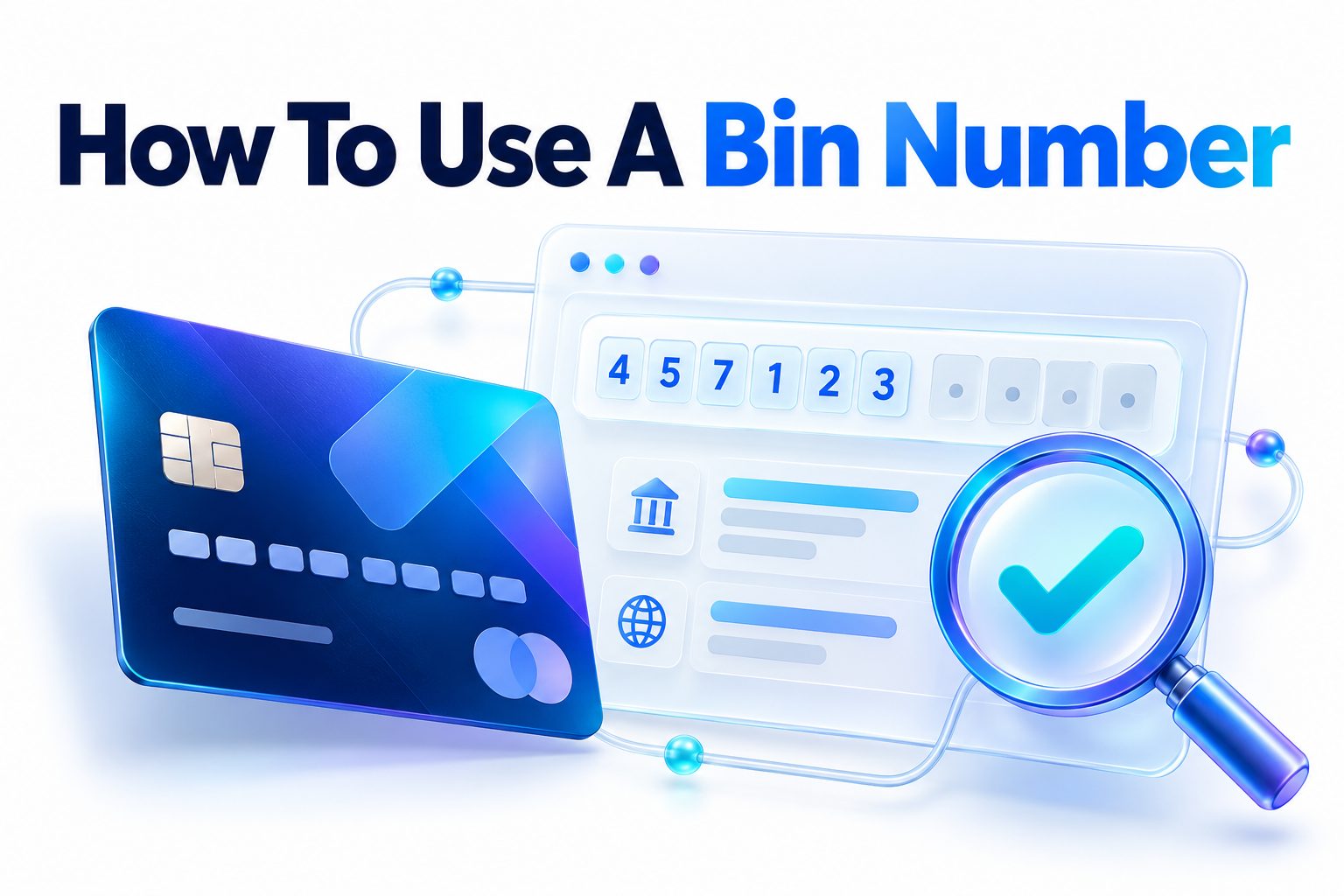
A BIN number helps businesses identify the financial institution, card network, card type, and issuing country associated with a payment card. Although people commonly say “BIN number,” BIN already means Bank Identification Number. It usually refers to the first six or eight digits printed on a credit, debit, prepaid, or charge card.
Learning how to use a BIN number is particularly useful for merchants, payment teams, fraud analysts, customer support staff, and developers working with online transactions. You can enter the digits into a reputable BIN lookup service or send them to a BIN database through an API. The resulting information can help you route payments, investigate declines, detect geographic inconsistencies, and apply appropriate acceptance rules.
A BIN lookup does not reveal the cardholder’s name, full account number, available balance, or transaction history. It is an identification tool rather than a complete method of verifying someone’s identity. This article explains how to perform a lookup, interpret each result, use BIN data responsibly, troubleshoot inaccurate matches, and combine the information with stronger payment-security controls.
What a BIN Number Identifies
A Bank Identification Number forms the opening portion of a payment card number. It identifies the organization responsible for issuing the card and places the account within a particular card program. Payment processors use this information during authorization to help send a transaction through the correct network and issuer.
Historically, BINs were generally six digits long. The industry has been transitioning to eight-digit Issuer Identification Numbers, or IINs, to create more available number combinations. Many lookup tools still use “BIN” as the familiar label, even when their databases support both six- and eight-digit identifiers.
The Information Available Through a BIN Lookup
A lookup result may identify the issuing bank, card brand, funding type, product category, country of issuance, and sometimes the issuer’s contact details. The exact fields depend on the quality of the database and whether the issuer has supplied current, detailed records.
BIN data describes a card range, not an individual cardholder. Two cards with the same opening digits may belong to different customers but share an issuer or product program. The remaining digits identify the individual account, while the final digit is normally used for a checksum calculation.
Important BIN Facts
- BIN stands for Bank Identification Number.
- IIN stands for Issuer Identification Number and is the formal industry term.
- A BIN is usually represented by the first six or eight card digits.
- It can identify an issuer, network, funding type, and issuing country.
- It cannot reveal the cardholder’s name, address, PIN, balance, or purchase history.
- It should support fraud screening rather than serve as proof of identity.
- BIN databases can contain incomplete, delayed, or conflicting records.
Finding the BIN on a Payment Card
Look at the long account number displayed on the front or back of the card. The first six digits provide a traditional BIN lookup value. When your payment provider or database supports eight-digit records, the first eight digits may return a more precise match.
For example, consider the fictional card number 41234567 8901 2345. A six-digit database would search for 412345, while an eight-digit system could search for 41234567. Never enter or share the complete card number when only the BIN is required.
Physical and Virtual Cards
The same principle applies to physical and virtual payment cards. A virtual card generally has a standard payment card number with an identifiable opening range, even though it may exist only in an app, digital wallet, or corporate expense platform.
Tokenized wallet credentials require more care. Apple Pay, Google Pay, and similar services may provide a device-specific payment token rather than transmitting the original card number. The token can have a different BIN, so its lookup result may not match the underlying physical card’s issuer details exactly.
Using a BIN Lookup Tool
The simplest way to use a BIN is through an online lookup service. Choose a provider that explains its data sources, update frequency, privacy practices, and limitations. Free databases can be helpful for occasional checks, but their records may be less complete than commercial payment-industry databases.
Only submit the minimum digits requested by the service. A legitimate BIN check does not require the full card number, expiration date, card security code, PIN, or cardholder name. Avoid any public website that asks for these details merely to identify an issuer.
Step-by-Step BIN Lookup
1. Locate the first six or eight digits of the card number.
2. Confirm whether the lookup service accepts six-digit BINs, eight-digit IINs, or both.
3. Enter only the required opening digits into the search field.
4. Review the returned issuer, network, country, card type, and product information.
5. Compare the result with information already available from the transaction or customer.
6. Treat mismatches as signals requiring further review, not automatic proof of fraud.
7. Record the lookup source and date when the result influences a business decision.
Interpreting BIN Lookup Results
A typical result contains several fields that must be read in context. The issuing institution field may show a bank, fintech company, credit union, retailer, or payment program manager. An unfamiliar issuer name does not automatically mean the card is invalid because some products are issued through banking partners.
The country field generally represents the country assigned to the card program or issuer range. It does not necessarily indicate the cardholder’s citizenship, residence, or current location. Someone can legitimately use a foreign-issued card while traveling, living abroad, or purchasing from an international merchant.
Card Network
The card network field may identify Visa, Mastercard, American Express, Discover, or another regional network. This result helps a merchant determine which processing route and acceptance rules may apply. Network identification can also support reporting, pricing analysis, and troubleshooting when a particular payment route experiences failures.
Do not rely on a BIN table alone to decide whether a brand is accepted. Your payment processor and acquiring bank determine the networks, regions, transaction types, and currencies your account can process.
Funding Type
The funding type normally classifies a card as credit, debit, prepaid, or charge. This distinction can affect transaction costs, cash-access rules, deposit policies, recurring payments, and risk controls. Some merchants also use it when certain services require a traditional credit card.
Classification is not always definitive. Hybrid products, newer fintech programs, and regional card categories may be labeled differently across databases. Ask the payment processor for authoritative transaction data when a funding-type decision affects eligibility or fees.
Card Level or Product
Some databases display categories such as Classic, Gold, Platinum, Corporate, Business, or Purchasing. These labels describe the issuer’s product range rather than the customer’s financial standing. They should not be treated as evidence of income, creditworthiness, purchasing power, or identity.
Product labels can still help with corporate expense workflows and payment analytics. For example, a business may separate commercial card volume from consumer card volume. Such classifications should be validated against processor data before they influence accounting or customer-facing policies.
Common BIN Fields and Their Meaning
Field | What it usually indicates | What it does not prove
BIN or IIN | Issuer-assigned card range | The cardholder’s identity
Network | Payment brand or processing network | That your merchant account accepts it
Issuer | Institution associated with the range | That the institution still uses the range
Country | Country assigned to the card program | Customer residence or current location
Funding type | Credit, debit, prepaid, or charge | Available funds or credit
Card level | Product tier or business category | Income, status, or spending capacity
Issuer contact | Published bank contact details | Ownership of a specific account
Practical Business Uses for BIN Data
Merchants frequently use BIN information to enrich transaction records. It can help customer support teams explain why a payment may be subject to international processing, identify the probable issuing institution, and determine whether a card is categorized as prepaid or commercial.
Payment and finance teams can also analyze approval rates by issuer, country, network, or funding type. Patterns may reveal routing problems or acceptance gaps. A sharp decline from one issuer, for instance, could indicate a processor configuration issue rather than a sudden wave of fraudulent customers.
Payment Routing and Acceptance
Large merchants may use issuer and network data to select an eligible processing path. Intelligent routing can improve authorization rates, manage processing expenses, or provide a fallback when one acquirer is unavailable. This work usually happens within a payment orchestration platform rather than through manual lookups.
Routing rules must follow network requirements, local regulations, and agreements with payment providers. A public BIN result is not sufficient for configuring live transaction routing. Use certified processor data and test each rule before applying it to production payments.
Transaction Review
During manual review, BIN data adds context to an order. A reviewer might compare the issuing country with the billing address, shipping destination, IP location, account history, and device signals. Several consistent details may support approval, while multiple unexplained inconsistencies may justify additional verification.
No single mismatch should automatically trigger rejection. A customer may use a card issued in a former country of residence, buy a gift for someone abroad, connect through a corporate network, or travel while ordering. Sound review policies allow for these ordinary situations.
Subscription and Deposit Policies
Certain businesses need to know whether a payment method is prepaid, debit, or credit. Hotels, vehicle rental companies, and subscription services may have different authorization, deposit, or renewal requirements based on the funding source. BIN information can provide an early classification before authorization.
The classification should be confirmed through the payment provider because databases can be outdated. Policies must also be clearly disclosed to customers. If a particular payment type is restricted, explain the rule before checkout rather than surprising the customer after an attempted purchase.
Useful BIN Applications
- Showing customers the expected card brand during checkout
- Measuring authorization rates by issuer and card category
- Investigating clusters of declines from a particular card range
- Applying lawful regional payment rules
- Distinguishing consumer and commercial card traffic
- Supporting manual fraud reviews with additional context
- Identifying possible prepaid cards for deposit-based services
- Directing transactions through eligible processing routes
- Troubleshooting card-brand or issuer-specific errors
Using BIN Data for Fraud Screening
BIN information can reveal inconsistencies worth investigating. For example, an order may use a card issued in one country, originate from an IP address in another, and request immediate delivery to a third. That combination increases uncertainty, especially when paired with a new account or unusually large purchase.
An isolated country mismatch is weak evidence because international shopping is common. Effective fraud screening evaluates the full transaction. Device reputation, account age, velocity, billing verification, authentication results, prior disputes, and customer behavior often provide more meaningful evidence than BIN data alone.
Building a Balanced Review Rule
Start by defining the risk pattern the rule is meant to address. A merchant facing repeated misuse of newly created accounts might review transactions combining a foreign-issued card, a high order value, expedited shipping, and several failed attempts. The BIN mismatch strengthens the pattern without controlling the decision.
Rules should be tested against legitimate transactions before enforcement. Measure false declines, chargebacks, review time, and approval rates. Overly broad country or prepaid-card blocks can reject reliable customers and may create legal, contractual, or reputational problems.
Geographic Mismatches
A BIN country can be compared with the billing country, IP geolocation, phone country code, and delivery destination. Agreement among these fields may lower uncertainty, but it never guarantees legitimacy. Fraudsters can imitate consistent data, while real customers routinely produce mismatches.
Give customers a reasonable path to resolve a review. Depending on the risk, that could involve 3D Secure authentication, confirmation through the issuing bank, or a different payment method. Do not request sensitive card details by email or an unprotected support channel.
Fraud Review Checklist
- Confirm the BIN source is current and reputable.
- Compare the issuing country with several transaction signals.
- Check order value, product risk, and requested delivery speed.
- Review device, account, and payment-attempt history.
- Consider travel, relocation, gifts, and corporate purchasing.
- Use issuer authentication when supported.
- Escalate ambiguous orders for manual review.
- Document the reason for approval or rejection.
- Monitor false positives after changing a rule.
- Never approve or decline solely because of a BIN lookup.
Integrating BIN Lookups Through an API
Businesses processing substantial transaction volume can use a BIN API instead of entering numbers manually. The application submits the first six or eight digits and receives structured fields, often in JSON format. Those fields can populate risk tools, analytics dashboards, payment forms, or support systems.
Before integrating a service, review its coverage, latency, uptime, rate limits, refresh schedule, and licensing terms. Confirm whether it supports eight-digit IINs and tokenized credentials. A low-cost API can become expensive if inaccurate classifications cause lost sales or unnecessary manual reviews.
A Typical Integration Flow
1. Receive card details through a PCI-compliant payment form or hosted payment page.
2. Let the payment provider tokenize the card whenever possible.
3. Extract or receive only the permitted BIN or IIN value.
4. Send the required digits to the selected lookup API.
5. Validate the response format and handle missing fields safely.
6. Combine the response with processor and risk-engine data.
7. Store only information that has a defined operational purpose.
8. Monitor lookup errors, response times, and classification accuracy.
Security and Privacy Considerations
A BIN by itself is not enough to complete a payment, but it still relates to payment infrastructure and should be handled carefully. Avoid publishing internal transaction patterns or unrestricted datasets that could assist card testing. Limit access to employees and systems with a legitimate need.
The full Primary Account Number is sensitive payment data. Organizations that store, process, or transmit it may have substantial PCI DSS responsibilities. Using hosted payment fields or processor tokens can reduce exposure. For more operational guidance, review [Internal Link: Secure Online Payment Processing].
Comparing Manual and Automated BIN Lookups
Manual searches work well for occasional support cases, testing, or investigating a small number of transactions. They require little technical setup, but results are slower and depend on employees choosing the correct database and interpreting each field consistently.
API-based checks suit recurring or high-volume workflows. They can standardize decisions and enrich records immediately, although they require development, monitoring, and error handling. Neither method eliminates the need for a payment processor, authentication service, or broader fraud controls.
Manual Lookup | API Lookup
Best for | Occasional checks and investigations | High-volume automated workflows
Setup | Minimal | Development and testing required
Speed | Depends on staff availability | Usually near real time
Consistency | Varies by reviewer | Standardized through application logic
Cost | Often free at low volume | Commonly subscription or usage based
Error handling | Reviewer interprets missing data | Application needs fallback behavior
Maintenance | Staff select and check sources | Developers monitor provider changes
Security | Risk of using untrusted websites | Requires secure data flows and credentials
Limitations of BIN Numbers
BIN databases are reference datasets, not real-time card-account records. Issuers can launch products, transfer portfolios, assign ranges to partners, or update product classifications. A database may therefore display an old institution, an incomplete label, or a country that seems inconsistent with the current card program.
Eight-digit issuance creates another limitation. Two cards may share the same first six digits but fall into different eight-digit ranges with different product details. A six-digit lookup can identify the broader family while missing the more precise issuer or funding classification.
A BIN Cannot Validate a Card
A lookup cannot confirm that a card number is active, has available funds, belongs to the person presenting it, or will be approved. Even a correctly formatted account number with a recognized BIN may be expired, blocked, fabricated, or used without authorization.
Only an authorization request through an approved payment processor can ask the issuer whether a transaction should proceed. Even then, approval confirms the payment decision at that moment; it does not independently establish the customer’s identity or eliminate dispute risk.
A BIN Cannot Replace Authentication
Cardholder authentication tools provide stronger evidence than a range lookup. Depending on the market and transaction, these controls may include 3D Secure, one-time verification, issuer-app confirmation, address checks, security-code checks, or risk-based authentication.
Use BIN results as one input within layered controls. Readers building an online checkout may also benefit from [Internal Link: Credit Card Fraud Prevention Methods], which should cover authentication, account protection, transaction monitoring, and customer-friendly review procedures.
Common Limitations to Remember
- Records may lag behind issuer changes.
- Six-digit results may be less precise than eight-digit matches.
- Different databases may return conflicting classifications.
- Tokenized wallet numbers may identify a token range.
- Issuing country does not confirm customer location.
- Card type does not confirm available funds.
- A recognized BIN does not prove that the remaining digits are valid.
- A lookup cannot replace authorization or cardholder authentication.
Troubleshooting Incorrect or Missing Results
First, verify that you entered only the opening digits and did not transpose any numbers. Check whether the service expects six or eight digits. Supplying eight digits to a six-digit-only form may cause an error, while a six-digit query may return a broad or ambiguous result.
Next, compare the lookup with information returned by your payment processor. Processor data often has greater operational relevance because it is connected to the actual transaction. If several trusted sources disagree, avoid making a firm decision from the BIN field alone.
No Match Found
A missing match can occur when a range is newly issued, privately managed, regional, or absent from a public database. It can also indicate a data-entry error. Try another reputable source and verify the card-brand pattern without submitting the complete number to a public service.
For a live transaction, rely on the payment gateway’s validation and authorization response. Do not conclude that the card is fraudulent merely because a free lookup site lacks a record. Record the gap and ask the data provider to investigate if it affects repeated transactions.
Wrong Bank or Country
An outdated database may show the original issuer after a portfolio transfer, merger, rebrand, or program change. The displayed country may represent the range’s registration rather than the location from which the customer obtained or currently uses the card.
Check the provider’s last-update date and compare its answer with the processor. Customer support staff should describe lookup results cautiously. Saying “the range appears associated with” is more accurate than insisting that a possibly outdated record definitively identifies the customer’s bank.
Debit and Credit Disagreement
Some products do not fit neatly into standard categories, and regional terminology varies. A card may route through one network while drawing directly from funds, or a commercial product may be classified differently by separate data suppliers.
When the distinction affects a deposit, surcharge, or eligibility policy, use authoritative processor information and the applicable network rules. Give the customer an alternative payment option if classification remains unclear.
Quick Troubleshooting Tips
- Recheck the first six or eight digits for typing errors.
- Confirm the lookup service’s required input length.
- Compare results from two established data sources.
- Prioritize transaction data from the payment processor.
- Check whether a digital wallet token was used.
- Look for issuer mergers, rebrands, or portfolio transfers.
- Treat blank fields as unknown rather than false.
- Avoid rejecting a payment solely because databases disagree.
Best Practices for Responsible BIN Use
Collect the smallest amount of data necessary for the task. A support agent investigating the issuer does not need the full card number, security code, or PIN. Mask card information in interfaces and logs, and never ask customers to send payment credentials through ordinary email or chat.
Document how BIN information influences business decisions. Clear policies help reviewers interpret country differences, prepaid classifications, missing data, and conflicting results consistently. They also make it easier to audit rules and identify practices that are rejecting too many legitimate customers.
Keep Data and Rules Current
Schedule regular database updates or choose an API provider that manages them. Review the business rules connected to BIN fields whenever your processor, markets, product range, or fraud pattern changes. A rule that worked last year may become inaccurate as issuers introduce new programs.
Measure outcomes instead of assuming a rule is useful. Track authorization rates, chargebacks, manual-review rates, customer complaints, and false declines. Remove or revise rules that add friction without producing a meaningful reduction in payment risk.
Communicate Clearly With Customers
When a transaction needs review, avoid accusing the customer of fraud based on issuer geography or card type. Explain that the payment requires verification and offer a secure next step. Neutral language protects the relationship and gives legitimate buyers a chance to resolve ordinary inconsistencies.
Train support employees to recognize the limits of lookup data. They should know what a BIN can reveal, which source the company uses, how to escalate conflicts, and which card details must never be requested. Consistent handling reduces both security exposure and customer frustration.
Do and Don’t List
Do:
- Use six- or eight-digit lookup data from a reputable provider.
- Combine BIN results with authorization and authentication signals.
- Keep databases and decision rules current.
- Protect all card-related information in logs and support channels.
- Provide a review or appeal path for legitimate customers.
- Test automated rules for false declines.
Don’t:
- Enter full card credentials into a public lookup website.
- Treat issuing country as proof of residence or location.
- Assume a recognized BIN confirms that a card is active.
- Block every prepaid, foreign, or unfamiliar card automatically.
- Use product tiers to infer income or creditworthiness.
- Replace processor authorization with a database search.
Conclusion
A BIN lookup is a practical way to identify the issuer, network, country, funding category, and product range associated with the opening digits of a payment card. For a basic check, enter only the first six or eight digits into a reputable lookup service. Businesses handling frequent checks can obtain the same data through an API and incorporate it into payment analysis, support workflows, or fraud screening.
The key to learning how to use a bin number is recognizing both its value and its limits. BIN data can add useful context, reveal patterns, and highlight transactions that deserve closer attention. It cannot identify the cardholder, confirm available funds, prove a card is genuine, or replace an authorization request.
Use current data, favor processor information when sources disagree, and evaluate each transaction through multiple signals. Protect full card details, document decision rules, and monitor false declines. Applied carefully, BIN information becomes a useful supporting tool that improves payment decisions without creating unnecessary obstacles for legitimate customers.
Frequently Asked Questions
What does BIN stand for?
BIN stands for Bank Identification Number. It describes the opening digits of a payment card number and helps identify the issuing institution, network, card category, and country associated with that particular card range.
Are BIN and IIN the same?
They are commonly used interchangeably. IIN, meaning Issuer Identification Number, is the more formal term because issuers are not always banks. BIN remains widely used by merchants, lookup providers, payment teams, and customers.
How many digits are in a BIN??
A BIN has traditionally contained six digits, but the industry also uses eight-digit IINs. Check which length your lookup provider supports, since eight-digit data can distinguish card ranges that share the same first six digits.
Can a BIN reveal the cardholder’s identity?
No. A BIN identifies the issuer or card program, not the individual account holder. It does not reveal a person’s name, address, PIN, account balance, transaction history, or ownership of a particular card.
Is it safe to use a free BIN checker?
It can be safe if the service is reputable and requests only six or eight opening digits. Never provide a full card number, expiration date, security code, PIN, or personal information for a basic lookup.