
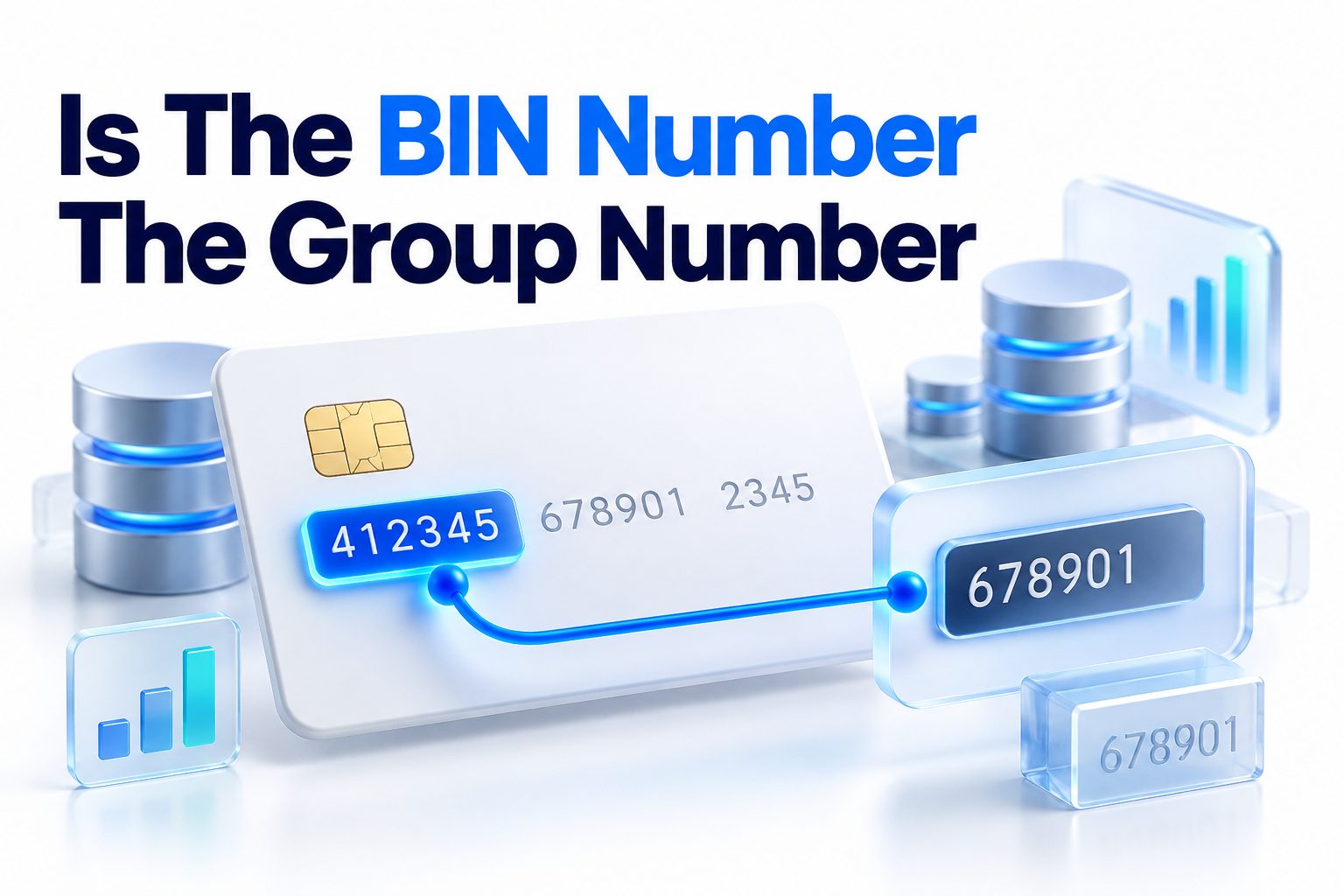
A health insurance card can contain several identification numbers, and their labels are easy to confuse. So, is the BIN number the group number? No. On a prescription insurance card, the BIN and group number serve different purposes. The BIN tells a pharmacy which claims processor or pharmacy benefit manager should receive the prescription claim. The group number identifies the specific employer plan, benefit package, or member group associated with your coverage.
You may need both numbers when filling a prescription, creating an online pharmacy account, or confirming drug coverage. Depending on the insurer, the group number may appear as “Group,” “GRP,” “Rx Group,” or “RxGRP.” The BIN usually appears as “BIN,” “RxBIN,” or “BIN Number” and normally contains six digits.
This article explains where to find each number, how pharmacies use them, what to enter on forms, and what to do when a number is missing. It also clarifies related fields such as the member ID, PCN, policy number, and bank card BIN so you can provide the correct information without delaying a prescription claim.
The Short Answer: BIN and Group Numbers Are Different
The BIN number is not the same as the group number. In prescription insurance, the BIN routes an electronic pharmacy claim to the correct claims-processing system. Think of it as a routing code that helps the pharmacy determine where the claim needs to go.
The group number narrows the claim to a particular insurance arrangement within that system. It may represent an employer, union, association, government program, or benefit design. People covered by the same employer-sponsored prescription plan often share a group number, while each member has a separate member ID.
Prescription Insurance Number Comparison
| Card field | Main purpose | Common format | Usually unique to one person |
|—|—|—|—|
| BIN or RxBIN | Routes a pharmacy claim to the proper processor | Usually six digits | No |
| PCN or RxPCN | Identifies a processing system, plan segment, or claim rules | Letters, numbers, or both | No |
| Group or RxGRP | Identifies the member’s plan group or benefit package | Letters, numbers, or both | Usually no |
| Member ID | Identifies the covered member or account | Letters, numbers, or both | Usually yes |
| Person code | Distinguishes family members under one account | Often two digits | Yes within the family |
What a BIN Number Means on an Insurance Card
In pharmacy benefits, BIN originally referred to a Bank Identification Number. Despite that name, the number on an insurance card does not mean your health plan is a bank account. It is an electronic routing field used in the pharmacy claim-processing system.
A pharmacy enters the RxBIN when submitting a claim for medication. The system uses that number to locate the correct processor, often a pharmacy benefit manager such as Caremark, Express Scripts, or Optum Rx. Several insurance plans can use the same processor and therefore may share a BIN.
The BIN alone does not identify your complete coverage. A pharmacy usually needs a combination of the BIN, PCN, group number, and member ID. If one field is entered incorrectly, the claim may be rejected even when your policy is active.
What the Group Number Identifies
A health insurance group number connects you to a defined coverage arrangement. With employer-sponsored coverage, it commonly identifies the plan purchased or administered for that employer. Insurers may also assign group numbers to union plans, student plans, associations, or particular benefit packages.
A group number is not always unique to a single employee or family. Many participants can share it. The member ID performs the more specific job of identifying your account, while a dependent code or person code may distinguish one covered family member from another.
Medical and prescription benefits may use different group values. Your medical card might show a general group number, while your prescription information lists a separate RxGRP. When a pharmacy asks for the prescription group, use the RxGRP rather than assuming the medical group number will work.
Why a Pharmacy Needs Both Numbers
Electronic prescription claims must reach the right processor and match the correct benefit configuration. The BIN handles the first part by directing the transaction. The group number helps the processor apply the rules associated with your plan after the claim arrives.
Those rules may determine the copayment, deductible, formulary tier, quantity limit, pharmacy network, or prior authorization requirement. Two members can use the same BIN but belong to groups with different benefits. That is why substituting one number for the other can produce an error.
A simplified claim path looks like this:
1. The pharmacy enters the medication and member information.
2. The RxBIN routes the claim to the correct pharmacy claims processor.
3. The PCN directs the claim within that processor’s system when required.
4. The RxGRP identifies the applicable plan group or benefit package.
5. The member ID links the claim to the covered person.
6. The processor returns an approval, a price, or a rejection message.
Where to Find the BIN and Group Number
Prescription processing information usually appears on the front of a combined health insurance card or on a separate prescription drug card. Look near labels such as RxBIN, RxPCN, RxGRP, Member ID, or ID Number. The fields may be grouped together in a small pharmacy benefits section.
Do not rely only on where a number appears. Card layouts differ between insurers, employers, and plan years. Read the printed label beside each value. A six-digit number near “RxBIN” is the BIN, while the value beside “RxGRP” or “Group” is the relevant group number.
Check Both Sides of the Card
Some cards place member details on the front and pharmacy processing information on the back. Digital cards may separate medical and prescription details across multiple screens. Expand sections labeled “Pharmacy,” “Prescription,” “Drug Benefits,” or “Rx Information.”
If the card shows only a member ID and medical group number, your prescription benefits may be administered by another company. Check your insurer’s member portal, pharmacy benefit manager’s app, enrollment documents, or welcome materials for a separate prescription card.
How to Enter the Numbers Correctly
Enter each value in the field that matches its label. A form asking for BIN should receive the RxBIN, not the group number or member ID. Preserve leading zeros because removing one can turn a valid six-digit routing number into an invalid entry.
For the group field, enter the value exactly as printed, including letters. Avoid adding spaces or punctuation unless they appear on the card and the form accepts them. When a form distinguishes between “medical group” and “Rx group,” choose the prescription value for pharmacy-related registration.
Use this checklist before submitting insurance information:
- Confirm that you are using the current insurance card.
- Match RxBIN to the BIN field.
- Match RxPCN to the PCN field.
- Match RxGRP or Group to the prescription group field.
- Enter the member ID exactly as shown.
- Include any suffix or dependent code attached to the member ID.
- Keep leading zeros in numeric fields.
- Verify the patient’s name and date of birth.
- Check whether the form requires the primary subscriber’s information.
Common Reasons the Numbers Get Confused
Insurance cards use small print, abbreviations, and layouts that vary widely. Some show medical and pharmacy information together, while others issue separate cards. A number may also appear without a clear explanation of whether it applies to medical claims, pharmacy claims, or both.
The terminology contributes to the confusion. “BIN” sounds like a bank-related number, “group” may appear more than once, and online forms sometimes use shortened labels. The most reliable approach is to match the exact label requested rather than guessing from the number’s length or position.
Similar Labels on the Same Card
A card may contain a medical group number, an Rx group number, a plan number, and a member ID. These are not automatically interchangeable. The medical group number helps administer healthcare claims, while RxGRP is designed for prescription claim processing.
Some plans use one group value across medical and pharmacy benefits, but that is a plan-specific choice. It does not make the BIN and group number equivalent. When both “Group” and “RxGRP” appear, pharmacies generally need the RxGRP.
Errors from Online Forms
An online pharmacy form may describe the field as “Group ID,” “Rx Group,” “Group Number,” or simply “Group.” If the form is collecting prescription coverage, it usually wants the value labeled RxGRP on your card.
A website may mark PCN or group as optional because certain plans do not use those fields. Do not invent a value or enter “N/A” unless the form instructs you to do so. Leave an optional field blank and contact support if the claim cannot be verified.
Common Mistakes to Avoid
- Entering the six-digit RxBIN as the group number
- Using the medical group when an RxGRP is printed separately
- Typing the policyholder’s member ID for a dependent without the required suffix
- Dropping zeros from the beginning of the BIN
- Confusing the PCN with the group number
- Using an expired card after a plan-year change
- Copying a number from a discount card instead of the insurance card
- Assuming every family member has identical member identification
BIN, PCN, Group Number, and Member ID Explained
The BIN, PCN, group number, and member ID work together, but each has a separate role. The BIN routes the claim to the processor. The PCN can direct processing within that organization. The group number identifies the benefit arrangement, and the member ID identifies the account.
Not every plan uses all four fields in the same way. A PCN may be blank, absent, or labeled differently. A group number may be optional for certain individual plans. The absence of a field does not necessarily mean that your coverage is incomplete.
The Role of the PCN
PCN stands for Processor Control Number. It helps the pharmacy processor distinguish between lines of business, benefit programs, or claim-processing rules. The format can contain numbers, letters, or both, and its length varies by plan.
Because the PCN sits beside the BIN on many cards, people sometimes enter it in the group field. Always follow the labels. If a pharmacy claim rejects after the card was copied correctly, the pharmacy can use the rejection response or call the processor for clarification.
The Role of the Member ID
The member ID identifies your insurance account or covered membership. It may also be called an identification number, subscriber ID, policy ID, or cardholder ID. Unlike the BIN, it is generally tied to an individual subscriber or covered household.
Dependents may share the subscriber’s base ID but have different suffixes or person codes. Other plans issue a distinct ID to every person. For more help distinguishing these fields, see [Internal Link: Health Insurance Member ID and Policy Number].
Real-World Examples of Using the Correct Numbers
Suppose a card lists RxBIN 123456, RxPCN ABC, RxGRP EMP789, and member ID X001234567. When a pharmacy submits a prescription, 123456 belongs in the BIN field, ABC in the PCN field, and EMP789 in the group field. None of those values replaces the member ID.
Now consider a card showing a medical group number of 445500 and an RxGRP of PLAN22. The pharmacy should normally use PLAN22 because it is specifically assigned to prescription processing. A doctor’s office billing a medical service may instead need the medical group number.
Practical Scenario: Registering with a Mail-Order Pharmacy
A mail-order pharmacy may ask you to add prescription insurance before placing an order. Start with the RxBIN and then provide the PCN, Rx group, and member ID if requested. Enter the patient’s identity exactly as the insurer has it on file.
If the site cannot validate the coverage, compare the digital card with the physical card and confirm that the plan is active. A recent change in employer benefits may have produced new processing numbers even when the insurance company’s name remained the same.
Practical Scenario: Using a Prescription Discount Card
Prescription discount cards also display BIN, PCN, group, and member identification fields. These values route a discount claim, not a health insurance claim. Give the pharmacy one card at a time so staff can compare the insurance price with the discount price.
A discount card usually cannot be combined with insurance for the same prescription transaction. Purchases made outside insurance may not count toward your plan deductible or out-of-pocket limit. Review [Internal Link: Prescription Discount Card vs Insurance] before choosing solely by the register price.
What to Do When the BIN or Group Number Is Missing
A missing number is not always a problem. Some plans do not require a PCN or group number, and certain systems can locate coverage using other information. The pharmacy should enter only the fields supplied by the plan rather than guessing.
If there is no RxBIN anywhere on the card, you may be looking at the medical side of your coverage. Search for a separate pharmacy card, check your member portal, or call the member services number. Your pharmacy may also be able to run an eligibility search.
Follow these steps:
1. Check the front and back of every current insurance card.
2. Open the insurer’s app or member portal and view the digital card.
3. Review enrollment or welcome documents for a pharmacy benefit manager.
4. Ask your benefits department whether prescription coverage uses a separate administrator.
5. Call the pharmacy services or member services number on the card.
6. Tell the representative that you need the RxBIN, RxPCN, RxGRP, and correct member ID format.
7. Ask the pharmacy to retry the claim using the confirmed information.
Troubleshooting a Rejected Pharmacy Claim
A rejection does not always mean your insurance is inactive. It may result from an outdated BIN, an incorrect group number, a missing dependent suffix, a refill-too-soon rule, an excluded pharmacy, or a medication requiring prior authorization.
Ask the pharmacy for the specific rejection message. That message often indicates whether the problem involves eligibility, routing, coverage rules, or the prescription itself. The next step depends on that reason, so repeatedly re-entering the same numbers may not solve the issue.
Coverage Changes and Old Cards
Employers can change pharmacy benefit managers without changing the medical insurer. When that happens, the RxBIN, PCN, or group number may change. An old card can look nearly identical to the new one but route claims to the wrong processor.
Compare the effective date and plan year before providing the card. Remove outdated digital images from your phone and keep the current card readily available. If coverage recently began, confirm that enrollment data has reached the pharmacy processor.
Name and Dependent Mismatches
Claims may fail when the pharmacy record does not match the insurer’s enrollment file. Differences in surname, date of birth, member ID suffix, or dependent code can prevent the processor from finding the patient.
Ask the insurer how each family member is listed. The pharmacy can then correct its profile without changing the prescription. Never alter the member ID based on a guess, because adding or removing a suffix can connect the claim to the wrong person.
Quick Troubleshooting Tips
- Read the rejection message before changing any fields.
- Verify the plan’s effective date.
- Compare the card with the insurer’s digital version.
- Confirm the patient’s legal name and date of birth.
- Check dependent suffixes and person codes.
- Make sure the pharmacy is in network.
- Ask whether prior authorization is required.
- Call the pharmacy benefits number rather than the general medical claims line when possible.
Medical Insurance Group Numbers Versus Rx Group Numbers
A medical group number is used in the administration of doctor, hospital, laboratory, and other healthcare claims. An Rx group number supports prescription benefits. They may match under an integrated plan, but they can also be completely different.
This distinction matters when a plan uses separate companies for medical care and medication coverage. A medical claim may go to the health insurer, while a prescription claim goes to a pharmacy benefit manager. Each administrator needs the identifiers assigned to its own system.
When One Card Covers Both Benefits
Many insurance cards combine medical and prescription information for convenience. The main member ID may work across both benefits, while separate pharmacy routing fields appear in a labeled Rx section. Use the general identification fields for healthcare providers and the Rx fields for pharmacies.
A combined card does not eliminate the different functions of the numbers. It simply places them in one location. Pay attention to labels and section headings, especially when supplying information over the phone.
When Separate Cards Are Issued
Some employers provide one card from the medical insurer and another from the pharmacy benefit manager. Present the medical card at a doctor’s office and the prescription card at a retail or mail-order pharmacy.
Keep both cards even if they display similar member information. The pharmacy card may contain the only valid BIN, PCN, and RxGRP. Uploading the medical card alone to an online pharmacy can delay verification.
BIN Numbers on Insurance Cards Versus Bank Cards
BIN has another meaning in payment processing. On a debit or credit card, a Bank Identification Number identifies the institution and card program that issued the payment card. It is associated with the opening digits of the card number and may also be called an issuer identification number.
That payment-card meaning is related historically but serves a different transaction system. A pharmacy RxBIN routes a prescription claim, while a payment card BIN routes or categorizes a financial transaction. Neither should be confused with an insurance group number.
Important Differences at a Glance
| Type of BIN | Found on | Purpose | Is it a group number |
|—|—|—|—|
| RxBIN | Health or prescription insurance card | Routes prescription claims | No |
| Payment card BIN | Credit or debit card number | Identifies the card issuer or network program | No |
| Insurance group number | Health or prescription card | Identifies a plan group or benefit arrangement | Not a BIN |
Protecting Your Insurance Information
A BIN or group number alone usually does not provide access to your benefits, but an insurance card contains several pieces of personal information. Treat the full card image carefully, especially when it includes your name, member ID, and plan details.
Send card images only through trusted pharmacy, provider, or insurer systems. Avoid posting them publicly or sharing them in unsecured messages. When requesting help online, redact your member ID, name, date of birth, barcode, and other identifying details.
Safe Information-Sharing Checklist
- Use the insurer’s official member portal.
- Confirm the pharmacy’s website address before uploading a card.
- Provide card details directly to authorized pharmacy staff.
- Redact personal identifiers from screenshots used for general advice.
- Do not post a full insurance card on social media or public forums.
- Report a lost card and request a replacement when necessary.
- Review benefit statements for unfamiliar prescriptions or services.
Conclusion
The BIN and group number are separate pieces of prescription insurance information. The BIN routes a claim to the correct processor, while the group number connects the member to a particular plan, employer group, or benefit package. A pharmacy may also need the PCN, member ID, and dependent suffix before it can process a prescription successfully.
When entering insurance details, copy each value from the matching label and preserve letters, leading zeros, and identification suffixes. Use the Rx group rather than a medical group when both are shown, and check that you have the current card after an employer or plan-year change. Missing fields should be confirmed through the insurer, pharmacy benefit manager, or benefits department instead of filled with a guessed value.
The practical answer to “is the BIN number the group number” is no: each field performs a different job. Reading the labels carefully and supplying the complete set of requested numbers is the simplest way to prevent routing errors and avoid unnecessary delays at the pharmacy.
Frequently Asked Questions
Can a BIN and group number ever match?
They could contain the same characters by coincidence, but they still represent different fields. Enter each value according to its printed label. Never assume one can replace the other merely because the values look alike.
Is the RxBIN always six digits?
RxBIN values used for pharmacy claim routing are generally six digits. Keep any leading zeros when entering the number. If the printed value has an unexpected format, confirm it with the pharmacy benefit administrator.
What should I enter when there is no Rx group?
Leave the group field blank if the form allows it, because some plans do not require one. If the field is mandatory, contact the insurer or pharmacy benefit manager rather than inventing a value.
Can family members share the same group number?
Yes. Family members covered through the same plan commonly share a group number. Their member IDs, suffixes, or person codes may differ, so the pharmacy must still use the correct identification for each patient.
Does a new insurance card mean a new BIN?
Not always, but the BIN, PCN, group number, or member ID can change when benefits are renewed or administrators change. Compare the new card carefully and stop using outdated prescription information.