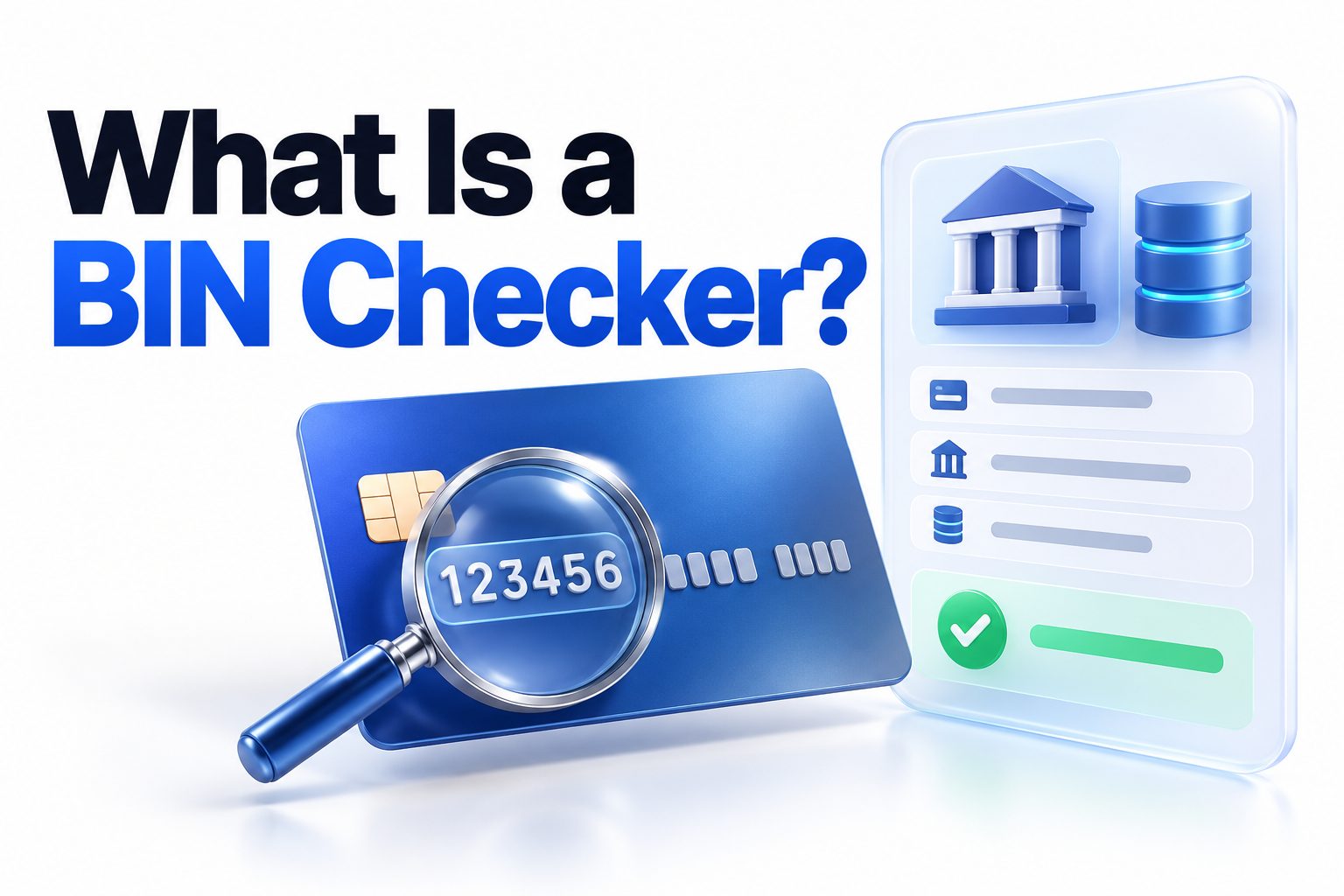
A bank card number contains more information than most people realize. Its opening digits identify the network, issuing institution, card type, and sometimes the country where the card was issued. A BIN checker reads those digits and matches them against a database of card-issuer records.
So, what is a BIN checker in practical terms? It is a lookup tool used to identify basic details about a payment card without revealing the cardholder’s name, account balance, address, or transaction history. BIN stands for Bank Identification Number, although the broader industry term is now Issuer Identification Number, or IIN.
Consumers may use a BIN lookup to recognize an unfamiliar card or check whether a website’s payment rules apply to their card. Merchants, fraud teams, and payment platforms use BIN data for routing, card acceptance, checkout customization, and risk screening. This article explains how BIN checkers work, which details they can reveal, how to use one safely, why results sometimes differ, and why a lookup should never be treated as proof that a transaction is legitimate.
What a BIN Checker Is
A BIN checker is a database lookup service that analyzes the first six or eight digits of a payment card number. Those digits act as an identifier for the organization that issued the card and the payment network associated with it.
The tool compares the submitted number with stored BIN or IIN records. It may return details such as the card brand, issuing bank, funding type, product category, and issuing country. The exact fields depend on the quality and age of the provider’s database.
The Difference Between BIN and IIN
BIN means Bank Identification Number. The term became common when banks were the primary organizations issuing payment cards. IIN means Issuer Identification Number and is more inclusive because credit unions, retailers, fintech companies, airlines, and other organizations may also issue cards.
People still commonly search for “BIN checker,” and many payment tools continue using that label. Within current card-numbering standards, IIN is the more accurate term. In most everyday conversations, though, BIN and IIN refer to the same identifying portion of a card number.
Six-Digit and Eight-Digit Identifiers
For many years, card identification relied mainly on the first six digits. As demand for new card ranges increased, the industry expanded issuer identifiers to eight digits. This created more available combinations and allowed issuers and networks to classify products more precisely.
Older lookup services may still rely on six-digit records. A newer service may use eight digits when they are available. This difference can explain why one tool provides a broad match while another identifies a more specific product, issuer, or region.
How Payment Card Numbers Are Structured
A payment card number is not a random sequence. It follows a standardized structure designed to help payment systems identify the network, locate the issuer, and check whether the complete number is mathematically valid.
Most card numbers contain three functional components: an industry or network identifier, an issuer identifier, and an individual account reference. The final digit is normally a check digit used to detect common typing errors.
The Major Industry Identifier
The first digit is known as the Major Industry Identifier, or MII. It places the card within a broad industry or numbering category. Certain starting digits are commonly associated with major payment networks, although the first digit alone is not enough to identify every card accurately.
A BIN checker considers a longer prefix rather than relying only on the MII. Card networks may have multiple assigned ranges, and ranges can change over time. Accurate identification therefore requires maintained issuer data instead of assumptions based on one digit.
The Account Identifier
Digits following the BIN or IIN generally identify the individual card account within the issuer’s assigned range. These digits are sensitive because they help distinguish one account from another. A public lookup does not need them to identify the issuer.
This is why a responsible BIN search requests only the first six or eight digits. Entering the complete card number creates unnecessary exposure and should be avoided unless the number is being submitted through a trusted, secure payment form for a real purchase.
The Check Digit
The last digit is usually calculated using the Luhn algorithm. Payment forms can use this check to spot many accidental errors before attempting authorization. A failed Luhn check suggests that the number was entered incorrectly or is not structurally valid.
Passing the check does not prove that a card exists, is active, has available funds, or belongs to the person using it. The algorithm checks number structure only. It is not a connection to the issuer and does not perform a payment authorization.
Key Card-Number Facts
- A BIN or IIN usually consists of the first six or eight digits.
- The opening digit provides a broad industry or network classification.
- Digits after the issuer identifier refer to the individual account.
- The final digit commonly serves as a mathematical check digit.
- A valid number format does not confirm an active or funded account.
Information a BIN Checker Can Reveal
A typical result starts with the card network or brand, such as Visa, Mastercard, American Express, or another payment scheme. It may also name the financial institution or organization responsible for issuing cards within that number range.
More detailed databases can classify the card as credit, debit, prepaid, or charge. Some also report the product level, issuing country, bank website, or customer-service phone number. Data availability varies considerably from one range to another.
Card Network
The card network manages the rules and infrastructure that allow transaction information to move among merchants, payment processors, acquirers, and issuers. Identifying the network can help a merchant display the correct card logo or determine whether a payment method is accepted.
Network identification is usually one of the more reliable fields in a lookup. Even so, merchants should use payment-provider data for actual transaction processing. A public checker is suitable for reference, not for directing live payments.
Issuing Institution
The issuer is the organization that provided the card account to the customer. It reviews authorization requests and decides whether to approve or decline transactions based on account status, available funds, security controls, and other factors.
A checker may display a bank name, but that name can be outdated or incomplete. Portfolios are transferred, institutions merge, and fintech cards may be issued through a partner bank. The name printed on the card may therefore differ from the legal issuer in the database.
Funding Type and Product Category
Funding type indicates whether a range is generally associated with debit, credit, prepaid, or another category. Merchants may use this information when certain payment methods have different acceptance rules, costs, or eligibility requirements.
Product categories can include labels such as classic, standard, business, corporate, platinum, or purchasing. These labels are not universally available or consistently defined across networks. They should be treated as classification data rather than a reliable measure of a cardholder’s financial status.
Issuing Country
The country field normally refers to the country assigned to the issuer or card range. It does not necessarily show where the cardholder lives, where the card is currently being used, or where the underlying account holder is located.
That distinction matters in fraud screening. A mismatch between the issuing country and the customer’s current location can be a useful signal, but it is not proof of fraud. Travelers, expatriates, international businesses, and users of global financial services regularly create legitimate mismatches.
What a BIN Checker Cannot Tell You
A BIN result does not reveal the cardholder’s name, billing address, personal identification number, security code, available balance, or purchase history. These details are not encoded in the first six or eight digits and should not be available through a public lookup.
The tool also cannot confirm ownership. Anyone who knows a card prefix can search it, and thousands or millions of cards may share that prefix. The result describes an assigned card range, not the identity or behavior of a particular cardholder.
No Confirmation of Card Status
A lookup cannot determine whether a card is active, expired, frozen, reported stolen, or closed. It does not communicate with the cardholder’s account in real time. Even a highly accurate match says nothing about whether an issuer would approve a transaction.
Only a properly submitted authorization request can return a current payment decision. That request should be made through a compliant payment processor during a legitimate transaction, not through improvised validation attempts or repeated low-value charges.
No Guarantee of Authenticity
Fraudsters may use card numbers with legitimate BINs. A genuine-looking bank, country, and card-type result therefore does not make the full card number trustworthy. Conversely, an incomplete database entry does not automatically mean that a legitimate card is fake.
A BIN check is one small part of payment analysis. Reliable decisions draw on multiple signals, including issuer responses, address checks where supported, security-code results, device data, customer history, transaction behavior, and strong customer authentication.
BIN Data Versus Sensitive Card Data
Data element | What it represents | Typical sensitivity
First six or eight digits | Issuer and card-range identifier | Useful for classification but still should be handled responsibly
Full card number | A specific payment account | Sensitive payment data requiring strong protection
Expiration date | Validity period printed on the card | Sensitive when combined with other card details
Security code | Card verification value | Highly sensitive and subject to strict handling rules
PIN | Cardholder authentication for supported transactions | Secret and never needed for a BIN lookup
How to Use a BIN Checker Safely
Choose a lookup service that asks only for the first six or eight digits. A basic search does not require the cardholder’s name, billing address, password, one-time code, PIN, expiration date, or security code. Requests for those details are a warning sign.
It is also sensible to review the site’s privacy information and connection security. Business users should prefer documented data providers that explain update schedules, coverage, licensing, and retention practices instead of relying on an unknown public form.
A Safe Lookup Process
1. Locate the opening digits of the card number.
Use only the first six digits for a traditional lookup or the first eight when the provider supports eight-digit IIN data.
2. Open a reputable BIN database.
Select a service with clear ownership, privacy terms, and information about where its data comes from.
3. Enter the prefix only.
Do not paste the complete card number, even if the website accepts more digits than it needs.
4. Review the returned fields.
Check the network, issuer, funding type, product classification, and country. Treat blank or uncertain fields as unavailable rather than guessing.
5. Confirm important information elsewhere.
For payment decisions, rely on your processor, acquirer, or card-network data. Consumers can contact the issuer using the number printed on the card or listed on its official website.
Privacy Precautions
Never send a full card number through email, chat, social media, or an unsecured support ticket simply to obtain a BIN result. Masked references, such as the first six and last four digits, are commonly used in support contexts, but they should still be shared only when necessary.
Businesses should restrict access to card data and follow applicable payment-security obligations. Staff members who only need issuer information should not be given complete account numbers. Data minimization reduces the damage that can result from logging mistakes, unauthorized access, or compromised systems.
Why Businesses Use BIN Lookup Data
Merchants use issuer data to make checkout experiences more relevant. A website might display accepted networks, tailor payment instructions, or determine whether a particular card category qualifies for a promotion. Payment platforms may also use range data to help route transactions.
Risk teams use BIN attributes as context for fraud rules. For example, a system may flag a large order when the card’s issuing country conflicts with several other signals. The mismatch prompts additional review; it should not automatically label the customer as fraudulent.
Payment Routing and Acceptance
Payment providers may maintain different acquiring connections, regional arrangements, or network configurations. Accurate card-range data can help identify the path appropriate for a transaction, although routing should be managed through payment infrastructure rather than a consumer-facing lookup page.
Some businesses also restrict unsupported products, such as certain prepaid or commercial cards. These rules need careful implementation because database errors can reject legitimate customers. The authorization response and processor capabilities should remain the operational source of truth.
Pricing and Commercial Card Identification
Card category can affect payment costs in some markets and arrangements. Finance teams may analyze transaction-level card classifications to understand their payment mix, compare processing costs, or identify the share of consumer and commercial cards they receive.
A public BIN checker is rarely sufficient for financial reporting. Reporting should use data supplied by the processor or acquirer, matched to settled transactions. Public tools may be useful for an occasional investigation but often lack the coverage and consistency needed for accounting decisions.
Fraud Screening
BIN data is valuable when combined with other risk indicators. A new account, unusually expensive order, high-risk delivery method, device-location mismatch, and issuing-country mismatch together may justify stronger verification or manual review.
The BIN alone is a weak fraud signal. Blocking all foreign-issued, prepaid, or debit cards can create false declines and exclude legitimate customers. A balanced system considers the customer’s full context and applies extra checks in proportion to the actual risk.
Practical Uses for BIN Information
- Showing the likely card network as a customer begins entering a number
- Checking whether a card type is supported before submission
- Comparing the issuing country with other transaction signals
- Separating debit, credit, prepaid, and commercial card activity for analysis
- Investigating why a promotion or payment rule was applied
- Supporting transaction routing within approved payment infrastructure
- Adding context to a manual fraud review without treating the result as proof
BIN Checkers and Fraud Prevention
Fraud prevention is one of the main reasons people search for BIN tools, but expectations need to be realistic. A lookup can identify an inconsistency worth reviewing; it cannot identify the person entering the card or determine whether that person has permission to use it.
Strong payment security combines multiple layers. These may include tokenization, issuer authorization, velocity controls, device analysis, account-history checks, address verification, security-code checks, and 3D Secure. The appropriate controls depend on the business model, region, and payment channel.
Useful Risk Signals
A card issued in one country while the customer claims another may deserve attention, particularly when delivery, device, and contact details also conflict. Yet international travel and cross-border banking are common, so the issuing country should never be evaluated in isolation.
Prepaid cards may carry different risk patterns for certain businesses, but they also serve many legitimate customers. The same principle applies to virtual and commercial cards. Good risk controls measure behavior and corroborating evidence instead of rejecting broad card categories by default.
False Positives and Customer Friction
Overly rigid BIN rules can block genuine purchases. A traveler may use a home-country card from a foreign IP address, while a company employee may place an order with a corporate card issued centrally in another country.
Every added restriction can affect conversion and customer support volume. Businesses should measure false declines, approval rates, chargebacks, and review outcomes. Rules that create substantial friction without reducing loss should be revised, narrowed, or replaced with stronger signals.
[Internal Link: Online Payment Fraud Prevention]
Common BIN Checker Limitations
BIN databases can become outdated because card programs change. Issuers merge, portfolios move between banks, new products launch, and old ranges are reassigned or reclassified. A lookup provider must continually collect and verify updates to maintain useful coverage.
Results may also be incomplete when a range is new, uncommon, regional, or managed through an issuing partnership. One field can be correct while another is missing. Users should distinguish “no data available” from “the card is invalid.”
Database Freshness
Update frequency is a major source of variation among tools. Free databases may rely on older snapshots or community submissions, while commercial providers often license data and issue scheduled revisions. Neither model guarantees that every record is current.
For a casual lookup, an approximate result may be enough. For payment routing, pricing, regulatory controls, or automated acceptance decisions, businesses need a provider with documented refresh cycles, coverage details, service commitments, and a process for correcting disputed records.
Co-Branded and Fintech Cards
A co-branded card can display the name of a retailer, airline, or membership organization even though a bank is the legal issuer. A checker may list the issuing bank rather than the consumer-facing brand, which can make a correct result appear unfamiliar.
Fintech programs create a similar situation. The app or financial brand manages the customer relationship, while a partner bank issues the card. Database providers may label the bank, the program manager, or both, depending on how their records are structured.
Country and Location Mismatches
The listed country reflects the card range, not the cardholder’s physical position. It may also reflect the issuer’s program setup rather than the location most closely associated with the customer. International card programs make simple country comparisons less reliable.
IP geolocation has limitations too. Mobile networks, corporate gateways, privacy services, and travel can produce unexpected locations. When both BIN and IP information are used, they should be treated as probabilistic clues supported by other transaction evidence.
Common Lookup Problems and Fixes
- No result appears: Try a provider that supports newer eight-digit identifiers or has broader regional coverage.
- The issuer name looks wrong: Check for a merger, portfolio transfer, co-branded program, or sponsor-bank arrangement.
- Two tools disagree: Compare their update dates and verify important details through a processor or official issuer source.
- The country seems incorrect: Remember that the result identifies the card range, not the cardholder’s current location.
- A valid card is labeled unknown: The range may be new, private, or missing from that database.
- A number passes validation but fails payment: Structural validity does not equal authorization or available funds.
Choosing a Reliable BIN Checker
A useful checker should disclose the number of digits it analyzes and provide clearly labeled results. It should also distinguish unknown values from confirmed classifications. Vague outputs and unexplained confidence claims make a service difficult to evaluate.
Privacy matters just as much as coverage. Avoid services that demand full card details, require unrelated personal data, or fail to explain how submitted numbers are handled. Businesses should review contractual, security, and compliance considerations before integrating an external API.
Data Quality and Coverage
Look for information about supported countries, networks, card types, update frequency, and correction procedures. A provider with broad global claims may still have weak coverage in the regions or specialist card programs that matter to your business.
Testing should use known, authorized sample ranges rather than live customer card numbers. Compare results against processor data and investigate systematic gaps. A short evaluation can reveal whether the service consistently identifies the networks, issuers, and product types relevant to your transactions.
API and Business Requirements
Companies often need an API rather than a manual search page. Important features include stable response formats, clear error messages, versioning, usage limits, uptime commitments, support, and secure transport. Response speed matters when the lookup affects checkout behavior.
Review how the provider licenses its data and whether results may be stored. Consider what happens when the service is unavailable. Checkout should normally fail gracefully, avoiding unnecessary declines merely because an enrichment database cannot respond.
Signs of a Trustworthy Service
- It requests only the minimum digits required for the lookup.
- It identifies whether results use six-digit or eight-digit data.
- It publishes coverage and update information.
- It labels unavailable fields clearly.
- It provides privacy terms and a recognizable business identity.
- It supports corrections or data-quality reports.
- It avoids claiming that a lookup proves card ownership or legitimacy.
- Its business API includes documentation, limits, and error-handling guidance.
BIN Checking Compared With Other Card Verification Methods
BIN checking provides classification data, while other payment controls serve different purposes. The Luhn algorithm checks number structure, authorization requests obtain issuer decisions, and security tools assess account or transaction risk. These methods complement one another rather than compete.
Confusing their roles can lead to unsafe decisions. A card may have a valid BIN and pass the Luhn check but still be declined. It may also receive authorization before later being disputed. No single check eliminates payment risk.
BIN Lookup Versus Luhn Validation
A BIN lookup identifies attributes associated with the opening digits. Luhn validation examines the complete number mathematically and detects many common entry errors. Neither method contacts the issuer or confirms that the person presenting the card is authorized to use it.
Checkout forms often run structural checks locally before sending a transaction to a payment processor. That reduces avoidable submissions caused by typing errors. The processor then performs the protected communication required for a genuine authorization decision.
BIN Lookup Versus Authorization
Authorization is a real-time request sent through payment infrastructure to the card issuer. The issuer may approve or decline it based on the account, transaction, security controls, and available funds or credit. A BIN lookup performs none of those functions.
Merchants should never attempt to “test” cards through unauthorized or artificial transactions. Legitimate businesses should submit payments only for real customer purchases using approved processing systems and should follow their provider’s rules for verification and authorization.
BIN Lookup Versus Address and Security-Code Checks
Address verification compares submitted billing information with issuer-held data in supported markets. A security-code check evaluates the verification value supplied during a card-not-present transaction. These checks return targeted responses through the payment processor.
BIN data cannot replace either control because the prefix contains no address or security code. Payment businesses can learn more about responsible card handling through [Internal Link: PCI Compliance Basics], especially when designing forms, logs, and support procedures.
Best Practices for Consumers and Businesses
Consumers should use BIN searches only for general identification and should never expose a complete card number to an untrusted service. If a card result seems suspicious, contact the issuer through an official channel rather than relying on a third-party website.
Businesses should obtain issuer data through established processors or vetted commercial providers. Build rules that allow for uncertainty, monitor their effect on legitimate customers, and keep raw card data out of analytics, logs, and support systems whenever possible.
Do and Don’t List
Do:
- Enter only the first six or eight digits.
- Use current, reputable data sources.
- Verify important results through official payment channels.
- Combine BIN information with several risk signals.
- Design automated rules to handle missing or uncertain data.
- Measure false declines and customer friction.
Don’t:
- Paste a complete card number into a public checker.
- Share an expiration date, PIN, password, or security code.
- Assume the issuing country is the cardholder’s location.
- Treat a successful match as proof of ownership.
- Reject transactions based on one BIN attribute alone.
- Use public lookup results as a substitute for authorization.
Conclusion
A BIN checker is a practical identification tool, not a window into someone’s bank account. By reading the first six or eight digits of a card number, it can usually identify the payment network, issuer, funding type, product category, and issuing country associated with that range.
The safest approach is to enter only the required prefix and treat the returned details as reference data. Results may be incomplete or outdated, especially for new ranges, co-branded products, fintech programs, and portfolios that have moved between issuers. Important business decisions should rely on maintained processor or network data.
For merchants, BIN information can improve checkout logic, reporting, payment routing, and fraud review when combined with stronger evidence. It cannot confirm identity, ownership, account status, available funds, or authorization. Consumers should use it for general identification and contact their issuer when they need an authoritative answer. The clearest takeaway is simple: use card-range data as context, protect the complete card number, and never let one lookup determine whether a person or transaction is trustworthy.
Frequently Asked Questions
Is a BIN checker legal to use?
Yes, checking a card prefix for general issuer information is typically lawful. The data identifies a card range rather than an individual. Users must still follow privacy, payment-security, contractual, and applicable local legal requirements.
Can a BIN lookup identify the cardholder?
No. It cannot reveal the cardholder’s name, home address, balance, or transaction history. The prefix is shared by many cards and identifies an issuer-assigned range, not a specific person or individual account.
Is it safe to enter a full card number?
No, a BIN lookup normally requires only the first six or eight digits. Entering the complete number into an unknown website creates unnecessary security risk and may expose sensitive payment information to an untrusted party.
Why do two BIN checkers show different results?
Their databases may use different sources, update schedules, and six-digit or eight-digit records. Issuer mergers, transferred portfolios, co-branded programs, and new card ranges can also produce conflicting or incomplete classifications.
Can a BIN checker confirm that a card is valid?
No. It can confirm that the opening digits match a known range, but it cannot verify account status, ownership, funds, or issuer approval. Only legitimate authorization through a payment processor can provide a current transaction decision.